

ILOILO CITY, Philippines — The Iloilo State University of Fisheries Science and Technology (ISUFST) started enforcing government austerity measures on Monday, March 9, in compliance with Office of the President Memorandum Circular No. 114, s. 2026. The directive forms part of the government’s effort to cut electricity and fuel use as oil prices climb due to ongoing tensions in the Middle East.
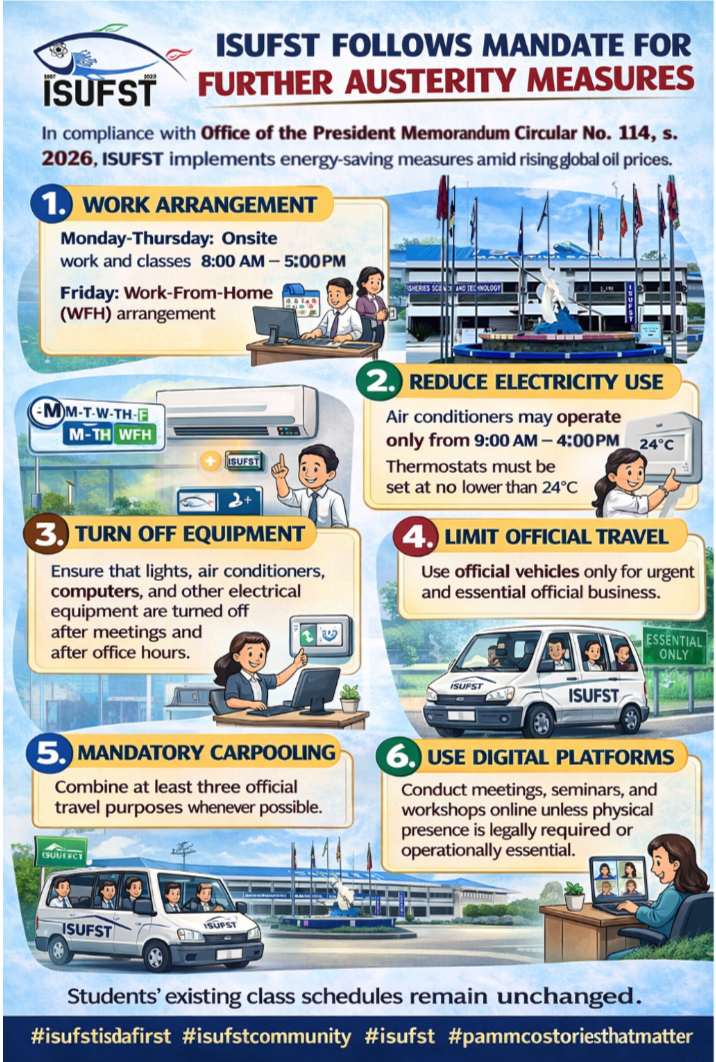
Following the order, ISUFST faculty, staff, contract-of-service personnel, and students were advised to observe a four-day onsite work and class arrangement from Monday to Thursday, with Fridays set for work-from-home duties where applicable. The guidelines also call for stricter control of electricity consumption, official travel, and in-person meetings to help reach the required 10 to 20 percent reduction in utilities while maintaining essential services. Note that students’ existing class schedules remain unchanged under the new directive.
Vice President for Administration and Finance Dr. Jescel Bito-onon explained the new austerity arrangement builds on ISUFST’s earlier Compressed Workweek (CWW), which began on February 2, 2026 for the second semester after approval by the Board of Regents on January 26. Under that setup—the first of its kind among universities in Western Visayas—personnel completed the full 40-hour workweek onsite, 7 a.m. to 6 p.m. daily, from Monday to Thursday. With the implementation of Memorandum Circular No. 114, however, the schedule now shifts slightly: about 32 hours, at 8 a.m. to 5 p.m. daily, will remain onsite while the remaining eight hours are completed through work-from-home arrangements on Fridays, a change expected to further reduce electricity use by roughly 20 percent.
ISUFST President Dr. Nordy D. Siason Jr. said the university’s response to the national directive remains anchored on efficiency, public accountability, and uninterrupted service. “We fully support this policy and will implement it both in spirit and in practice,” Siason said. “Everyone in the university community is expected to observe it responsibly so we can continue delivering services while doing our part in conserving energy.”
Aside from the Monday-to-Thursday onsite schedule, the university reminded the community that air conditioners be strictly operated only from 9 a.m. to 4 p.m., with thermostats set at no lower than 24 degrees Celsius. Offices were also instructed to ensure that lights, air conditioners, computers, and other equipment are turned off after meetings and after office hours.
The use of official vehicles, meanwhile, has been limited to urgent and essential business only. Carpooling has also been made mandatory, with unit heads asked to combine at least three official travel purposes whenever possible. Meetings, seminars, and workshops are likewise to be conducted through secure digital platforms unless physical presence is legally required or operationally necessary.
For VPAA Dr. Stephen Raymund Jinon, the challenge is to keep learning delivery steady while adjusting operations to national energy-saving requirements. “The policy gives us flexibility, but it also demands discipline,” Jinon said. “Academic delivery remains non-negotiable, and student learning will not be compromised.”
The university earlier said frontline and academic support offices must continue using rotation, skeleton workforce, or alternative arrangements to ensure that essential services remain available. Units assigned to fishponds, farms, agricultural stations, and other field-based facilities also remain under separate schedules because of the nature of their work.
University officials said the school continues to monitor actual savings in electricity, water, and fuel. Data on attendance, productivity, service delivery, and utility use will continue to be reviewed during the semester.
The austerity measures under MC 114 will remain in effect until lifted by the national government. Once that happens, ISUFST is expected to assess whether it will fully revert to its original CWW scheme or make further adjustments based on the results of its monitoring.
The latest move also reflects ISUFST’s commitment to the UN SDGs—especially clean energy, responsible resource use, and accountable institutions—showing how public universities can respond to national challenges with discipline and care.| Herman Lagon/PAMMCO