

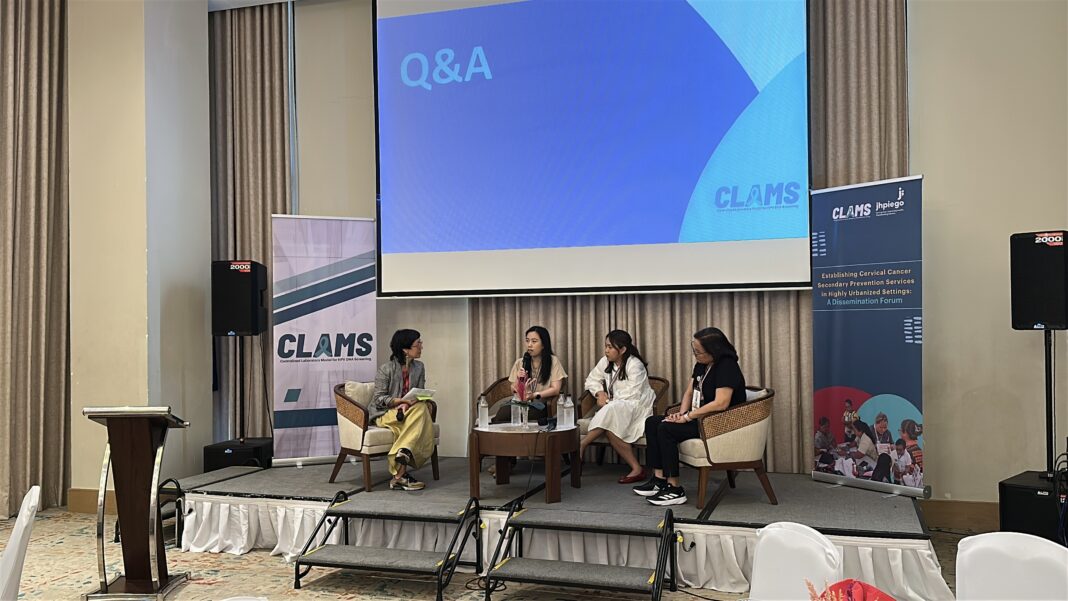

CEBU CITY, Philippines — Health leaders and policymakers gathered at the Citadines Hotel Cebu this Tuesday, March 31, to chart a path for the nationwide scaling of cervical cancer prevention services following the successful implementation of the Centralized Laboratory Model for HPV Screening (CLAMS) Project Phase 2. The dissemination forum, titled “Establishing Cervical Cancer Secondary Prevention Services in Highly Urbanized Settings,” showcased how Cebu City’s systems-based approach has significantly bridged the gap in early detection and treatment for a disease that claims the lives of 12 Filipino women every day.
The project introduced a hub-and-spoke delivery system and a centralized laboratory for HPV DNA testing, which is the global standard for detecting high-risk infection. Data presented during the forum revealed that from January to November 2025, screening coverage in Cebu City grew from less than 1 percent to 3 percent. More importantly, the initiative successfully linked 80 percent of women who tested positive for HPV to clinical care, a stark improvement in a country where many patients with abnormal results are often lost to follow-up due to cost and distance.
Dr. Vanessa Tawi, Cebu City Cervical Cancer Control Program Manager, highlighted the importance of these structural changes in the local health landscape. “This initiative shows that with the right systems in place, we can bridge long-standing gaps in women’s health services,” she stated. “The results affirm that a coordinated, systems-based approach can significantly improve early detection and ensure women receive the care they need on time.”
The project’s success relied on more than just medical technology; it focused on workforce capacity, data systems, and governance to ensure services remain patient-centered within urban primary healthcare settings. Cebu City Health Officer Dr. Daisy Villa emphasized that the initiative’s impact was rooted in accessibility. “We have seen firsthand how bringing services closer to women, while ensuring strong referral systems, can save lives. This is not just about expanding services; it is about making them accessible, responsive, and truly centered on the needs of women,” Dr. Villa said.
As the Philippines looks toward the goal of eliminating cervical cancer as a public health threat, the CLAMS 2 Project serves as a proven model for other regions in Central Visayas and across the country. Dr. Ingrid Magnata, Country Program Manager of Jhpiego Philippines, noted that the initiative proves effective prevention is possible even in complex, highly urbanized environments. “The CLAMS 2 Project demonstrates that effective cervical cancer prevention is achievable even in complex urban settings. By strengthening health systems and ensuring women are not lost along the care pathway, we are moving closer to eliminating cervical cancer as a public health threat,” Dr. Magnata concluded.|