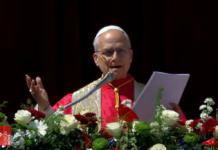


Donald Trump recently went after Pope Leo XIV, calling him “weak” and implying he should keep out of world issues. It came out in that familiar tone—straight, cutting, almost like it was obvious. The Pope did not respond like that. He stayed where he has always been—talking about peace, about slowing things down, about not rushing toward harm just because it feels decisive. You could feel the gap between them. One voice pushing hard, certain, unbothered. The other holding ground quietly, almost stubbornly, refusing to turn away from what he believes matters. That gap is the story—and it is wider than it first appears.
At first, it might seem simple to explain—like oil and water, two things that just do not mix. One loud, one measured. One pushing forward, one holding back. Easy to separate, easy to take sides. But if you stay with it a little longer, it does not feel that clean. Because these voices do not stay apart. They meet—in conversations, in homes, in how people think and choose. And that is where it starts to feel more complicated.
To be clear, this is not just another disagreement you scroll past. When someone who keeps insisting on peace gets brushed off as “weak,” something in that should give us pause. You do not have to be Catholic for that. You do not have to be religious at all. It is simply the sense that trying to keep people from getting hurt should not be treated as a flaw. And yet, it often is—quietly, almost casually.
It makes you wonder what we now call strength. Is it the loudest voice? The one that sounds most certain, even when things are messy? The one that cuts through everything quickly, even if it leaves things out? There is a kind of appeal to that, especially when people are tired. It feels like movement. It feels like something is finally happening. But there is also a cost to that kind of certainty—one that is usually paid by people who never got to speak in the first place.
The Pope’s voice does not work that way. It does not rush to finish the sentence. It lingers a bit. It sounds like someone who knows that once harm is done, it does not easily undo itself. When he talks about peace, it is not abstract. It is not detached. It is grounded in the idea that lives—actual lives, not talking points—are always at stake. It may not sound strong in the usual sense. But it endures.
What stays with me, though, is not just what Trump said. It is how easily it slid past so many people. No real pushback. No real unease. Just a quick line—“That’s just him.” Or even approval—“At least he’s honest.” Say that often enough, and even the unacceptable begins to feel familiar.
We have seen this before, and closer than we might like to admit. When Rodrigo Duterte was president, he said things that would have once shocked us. He insulted Pope Francis openly. He made remarks about God, even about Jesus Christ, that many would have once drawn a line against. And yet, a lot of people did not step back. Some laughed. Some defended him. Some said it was just his way—that it was part of what made him real.
It does not end there—and it is not just in one place. Trump himself once shared an AI image of himself as Christ—something that would have caused outrage before. But this time, many just shrugged. Some laughed, others defended it, a few even admired it. And when something that touches faith is taken lightly and we barely react, it tells us something—not just about leaders, but about how easily we move our own lines.
If you try to hold those two things together—valuing faith, valuing respect, and then accepting that kind of language—it does not quite settle. There is a tension there. And instead of sitting with it, we smooth it over. We explain it away. We make it smaller than it is. Not because it makes sense, but because it is easier.
There is a term for that—cognitive dissonance—but you do not really need the term. You know the feeling. It is that quiet friction inside when what we believe and what we tolerate no longer match. And over time, if we are not careful, it is not our behavior that adjusts—it is our standards.
And honestly, you do not need religion to notice it. Even without faith in the picture, there is still that basic question of decency. When a call for peace is dismissed, or when someone known for restraint is ridiculed, something does not sit right. Not loudly, not dramatically—but enough to remind us that some lines are meant to hold.
This is not about putting the Pope on a pedestal. No one is beyond question. But there is a difference between disagreeing and dismissing, between pushing back and talking down. When that line blurs, it does not stay contained. It spills into how we speak, how we argue, how we begin to treat one another.
At the same time, it would not be fair to ignore why some people lean toward Trump’s tone. There is real frustration out there. Things move slowly. Promises stretch thin. Words about peace can start to feel repetitive, even empty. And in that kind of environment, decisiveness can feel like relief. It feels like finally getting somewhere.
But even then, something should remain. We can be frustrated, yes—but not careless. Not at the cost of how we speak about others, especially those trying, however imperfectly, to prevent harm. Because strength that cannot slow down, cannot hold back when it should, eventually stops being strength. It just becomes noise.
The Pope did not meet loudness with loudness. He stayed where he has always been—on the side of peace, even when people are not listening. There is something quietly firm about that. It does not demand attention, but it holds its ground.
And maybe that is why this lingers. It does not give easy answers. It leaves a question instead: when something feels off, do we brush it aside—or do we sit with it long enough to understand why?
Because this goes beyond Trump. Beyond the Pope. It is not even just about Duterte.
It is about us—about what we notice, what we excuse, what we slowly learn to live with.
Not oil and water. Something closer than that. Something that does not separate cleanly, but settles into us—into how we think, how we speak, how we choose.
And maybe the harder truth is this: it is not just what we believe that is changing. It is what we are slowly learning to excuse.|