
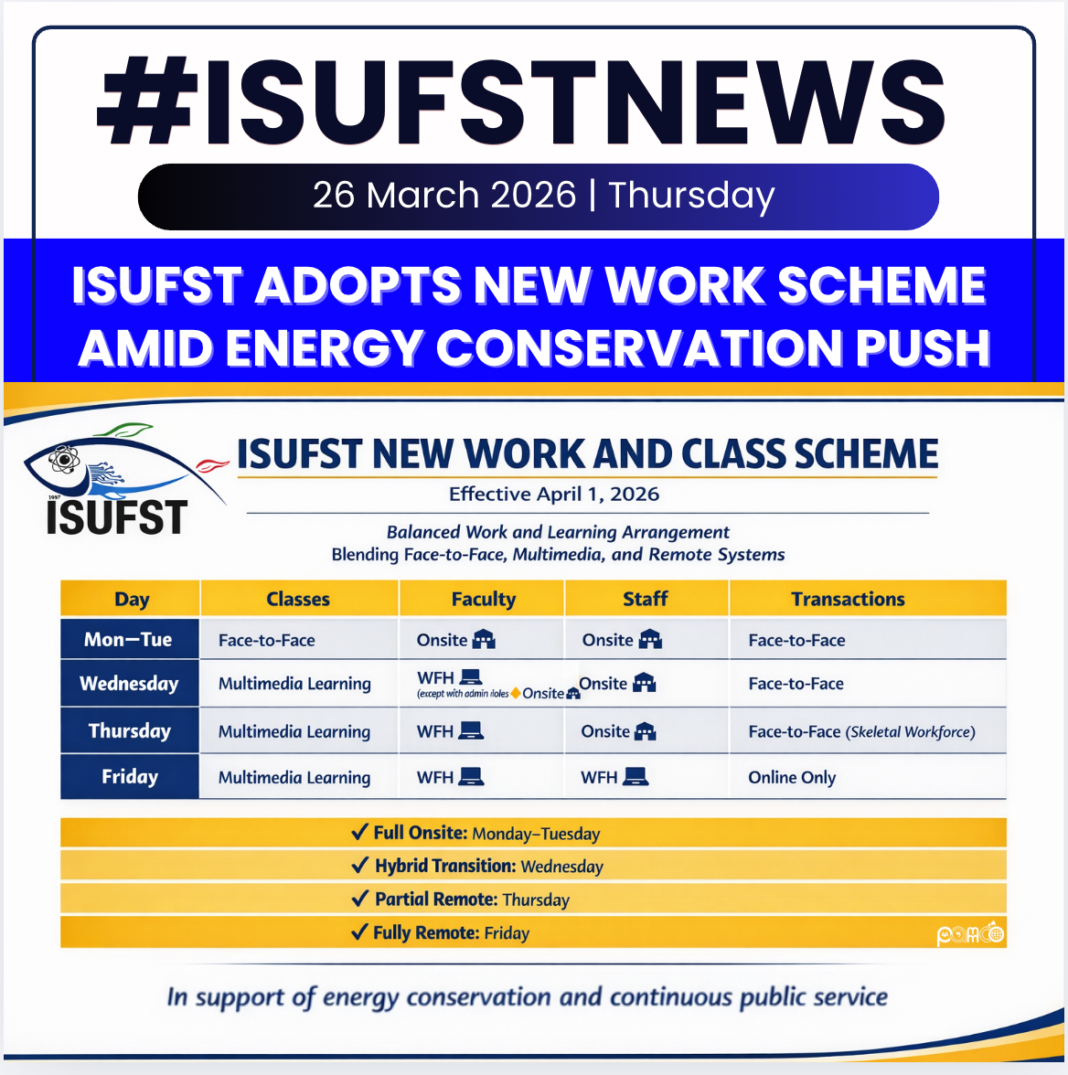

BAROTAC NUEVO, Iloilo — Following approval from the Board of Regents on Wednesday, March 25, the Iloilo State University of Fisheries Science and Technology (ISUFST) will implement a refined hybrid work and class schedule starting Wednesday, April 1, 2026.
The updated scheme balances on-site presence with remote efficiency to answer the government’s call for energy conservation without disrupting academic and administrative excellence. The university will transition from high-density campus activity to fully remote operations as the week progresses.
The week begins with intense energy on Mondays and Tuesdays, dedicated to full in-person operations where students and personnel converge for face-to-face classroom interaction and essential institutional coordination. By Wednesday, the momentum shifts into a transitional phase as classes move to multimedia learning. The faculty without administrative roles work remotely, while key officials and non-teaching staff remain on-site to anchor university operations.
This digital migration deepens on Thursdays, with the majority of the community working from home, while a dedicated skeletal workforce maintains a physical presence for urgent transactions. The cycle culminates on Friday with a fully remote setup, moving all classes and services online to maximize efficiency and achieve the university’s lowest on-campus energy consumption for the week.
University officials emphasized that the new arrangement is not a reduction of work, but a recalibration of how it is done. “This is not about doing less work. It is about doing work more wisely,” ISUFST President Dr. Nordy D. Siason Jr. said, underscoring that the university remains committed to the required 40-hour workweek and uninterrupted academic delivery.
Vice President for Administration and Finance Dr. Jescel Bito-onon shared that the new setup is really about finding a better balance—keeping operations efficient while being mindful of costs. With fewer on-site days and more intentional energy use, the university is able to support national efforts without slowing down its work.
Dr. Jescel Bito-onon, VP for Administration and Finance, noted the shift aims for a “better balance” by cutting operational costs, while Dr. Stephen Raymund Jinon, VP for Academic Affairs, emphasized that “learning must move forward without compromise.”
Students, meanwhile, will continue following their class schedules with adjustments primarily in delivery format rather than expectations. For many, the balance offers both stability and flexibility. “What matters most is that learning continues and support remains available,” Federated University Student Council President and Student Regent Rjay Pahuganoy shared. “The format may change, but the learning should not.”
Essential units—including security, farms, and fishponds—will maintain specialized schedules to ensure campus safety and productivity. The Human Resource Management Office (HRMO) will monitor the rollout to evaluate service delivery and energy savings, ensuring the university remains “open” for business, even when the physical gates are closed.| Dr. Herman M. Lagon