

MANILA — The Philippines has failed to secure a non-permanent seat on the United Nations Security Council (UNSC) for the 2027 to 2028 term, losing the sole available slot for the Asia-Pacific regional group to Kyrgyzstan after an intense four-round voting process on Wednesday.
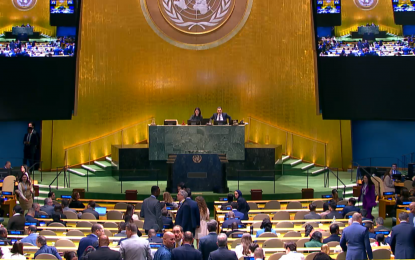
During the final count at the UN General Assembly (UNGA) in New York City, Manila failed to secure the required two-thirds majority of 128 votes from the 191 UN member states present.
The final ballot concluded with a decisive 49-142 outcome in favor of Bishkek. The election stretched into multiple cycles after initial voting rounds failed to yield a clear winner, with support for the Philippines gradually declining from 85 votes in the first round to 81 and 68 votes in the second and third ballots, respectively.
In an official statement released after the election, Foreign Affairs Secretary Ma. Theresa Lazaro stated that Manila respects the collective decision of the UN member states and offered congratulations to Kyrgyzstan on its victory.
Despite the outcome, Lazaro maintained that the Philippines “remains committed to working with all nations in pursuing peace, stability, sustainable development, and a rules-based international order.”
“Our campaign was anchored on our longstanding commitment to peace, dialogue, international law, and cooperation among nations. These remain principles that the Philippines will continue to uphold and advance in the global community,” she said.
The defeat comes despite a concerted diplomatic campaign by the administration. In March, President Ferdinand Marcos Jr. made a personal pitch for the country’s candidacy, positioning the Philippines as a “voice for principled peace” and a balancing force in global affairs. At the time, Marcos expressed strong confidence in Manila’s diplomatic leverage.
“Well, we have the advantage, and this is what I highlighted in my speech — that the advantage the Philippines has is our very strong record of partnership with the UN over the years,” Marcos previously stated during a press conference.
While Kyrgyzstan will join the powerful council for the first time in its history, four other nations—Austria, Portugal, Trinidad and Tobago, and Zimbabwe—successfully secured the remaining available non-permanent seats.
These five newly-elected members are slated to replace outgoing council members Pakistan, Denmark, Panama, Somalia, and Greece, whose terms will officially expire on December 31, 2026.
The UNSC remains the premier global body tasked with maintaining international peace, wielding the authority to issue legally binding resolutions that can mandate economic sanctions, military action, or peacekeeping deployments.|