
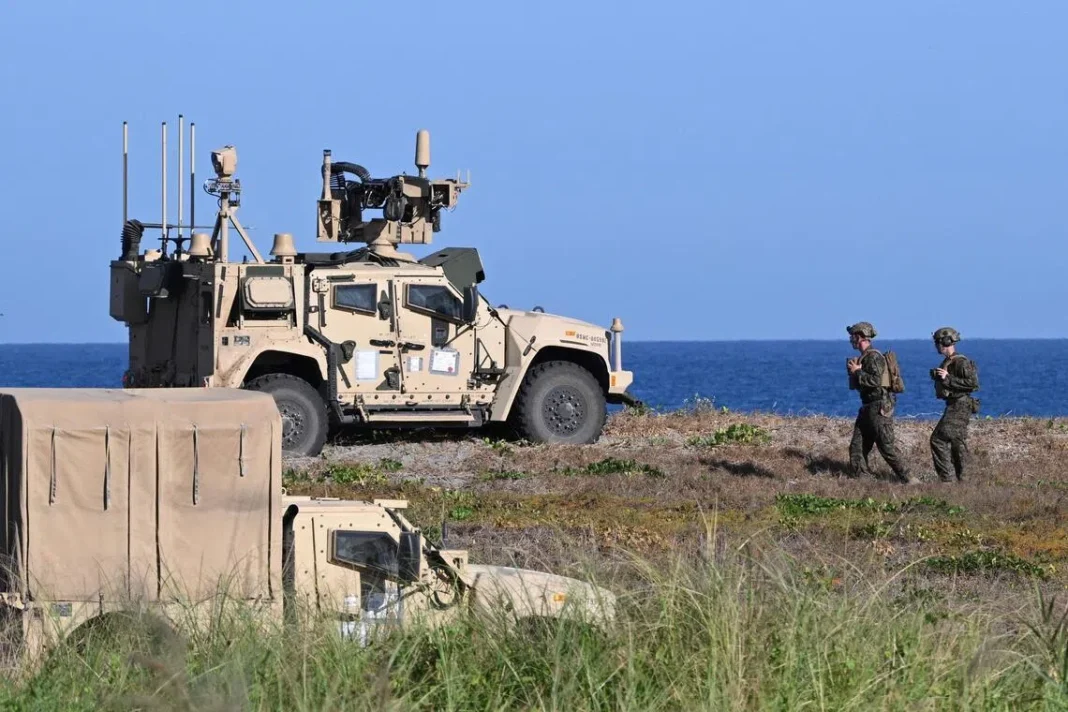

MANILA, Philippines — In a historic display of long-range strike capabilities, the United States (U.S.) military successfully test-fired the Typhon mid-range capability system on Philippine soil for the first time shortly after midnight Tuesday, May 5. The landmark activity, conducted as part of the ongoing Balikatan exercises, saw a Tomahawk cruise missile launched from Tacloban City Airport in Leyte, traveling approximately 600 kilometers along the country’s eastern seaboard before striking its intended target at Fort Magsaysay in Laur, Nueva Ecija.
Balikatan spokesperson Col. Dennis Hernandez confirmed to reporters that the subsonic missile, capable of striking targets up to 1,000 miles away, carried no explosive payload and was used primarily to assess accuracy. The launch formed part of a simulated combat scenario intended to support ground troops responding to an enemy force.
Hernandez noted that the missile passed through the area of Dingalan, Aurora, roughly an hour after launch. Prior to the test, the Philippine Army conducted information drives in local communities to prevent public alarm, following a navigational advisory issued by the Coast Guard to warn mariners in San Pedro Bay.
The deployment of the land-based Typhon system, which can fire both Tomahawk and SM-6 missiles, has remained a point of significant geopolitical friction. While the system was flown nearly 13,000 kilometers from Washington State to serve as a strategic asset, China has repeatedly condemned its presence, claiming it introduces “risks of geopolitical confrontation and arms race into the region.”
US Army Pacific commander General Ronald Clark emphasized on Monday that the Typhon is “highly requested by a number of our partners and allies and it’s at their request that we deploy.” He described the system as a “pretty strategic deterrent capability.” The US Army pursued this mid-range capability specifically to fill a tactical gap, providing a system capable of sinking ships at strategic distances that were previously out of reach for shorter-range systems.
With over 16,000 troops participating from various nations including Australia and Japan, the drills have evolved in complexity to include maritime strike operations and integrated air defense. The Typhon test-fire precedes a major maritime strike drill scheduled for May 6 in Laoag, Ilocos Norte, which is expected to be observed by the defense ministers of the Philippines and Japan.|