

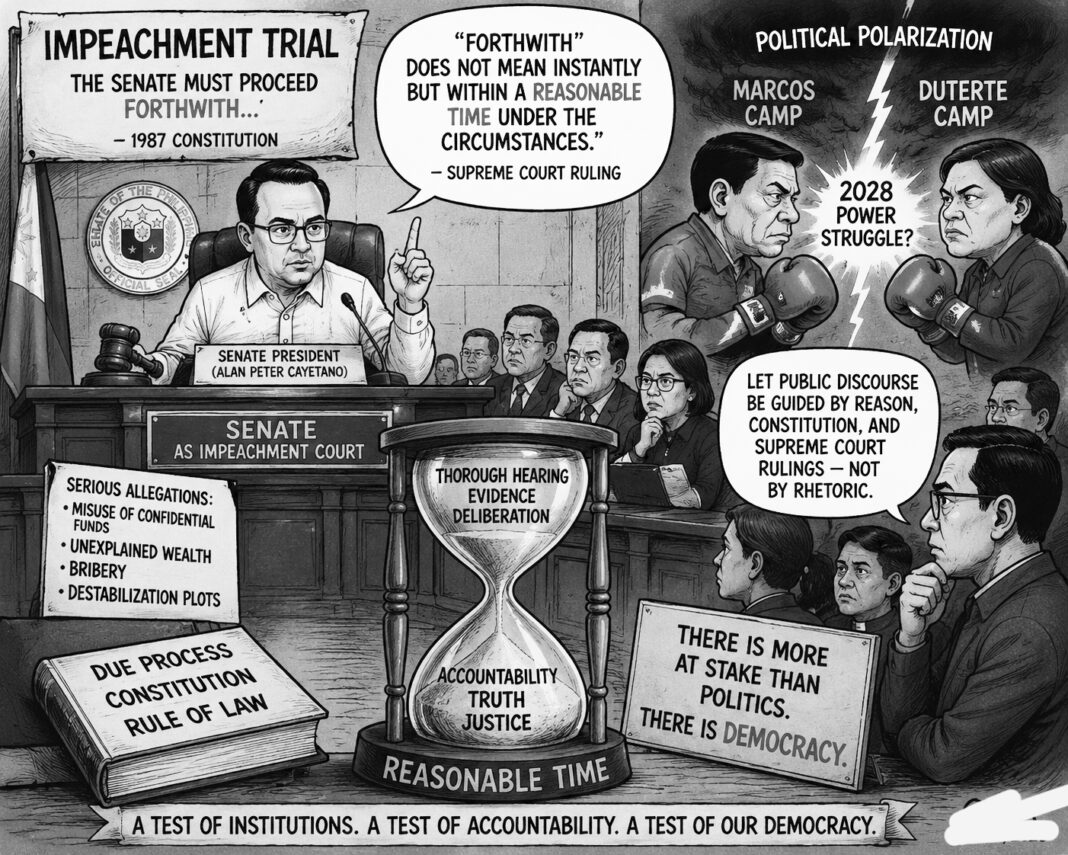

The Senate must proceed with the impeachment trial of Vice President Sara Duterte as mandated by the 1987 Constitution. However, calls for the chamber to act “forthwith” should also be understood within the context of constitutional jurisprudence and established rulings of the Supreme Court of the Philippines.
The Constitution indeed requires the Senate to proceed forthwith once Articles of Impeachment are transmitted by the House of Representatives. Yet the High Court has previously clarified that “forthwith” does not necessarily mean instantaneous or immediate action, but action within a reasonable period under the circumstances.
This distinction is important as political tensions continue to rise following the Senate leadership change that installed Alan Peter Cayetano as Senate President.
The impeachment complaint against Duterte involves serious allegations, including misuse of confidential funds, unexplained wealth, bribery, and alleged destabilization plots. These accusations have further exposed the widening political divide between the Marcos and Duterte camps — a rivalry many believe could shape the 2028 presidential elections.
As the Senate prepares to convene as an impeachment court, the central issue now goes beyond personalities and political alliances. The real test lies in whether institutions can uphold accountability, due process, and constitutional order amid intense political pressure.
Under the Constitution, the Senate acts as an impeachment court, with the Senate President presiding over proceedings. While the presiding officer votes only under limited circumstances, the position carries significant influence over procedure, scheduling, and the overall conduct of the trial.
The leadership transition from former Senate President Vicente Sotto III to Cayetano has inevitably fueled public debate over whether the impeachment proceedings will move swiftly, cautiously, or become entangled in partisan politics.
Still, despite growing political polarization, it remains essential that public discourse — including statements from political blocs, civil society, and even religious institutions — remain grounded in constitutional processes, reasoned analysis, and Supreme Court rulings rather than rhetoric alone.
Ultimately, the impeachment proceedings are not merely about one official. They have become a broader test of institutional strength, democratic accountability, and the balance of power within Philippine politics ahead of 2028.|– [Syndicated Editorial for BNN Media Group]