
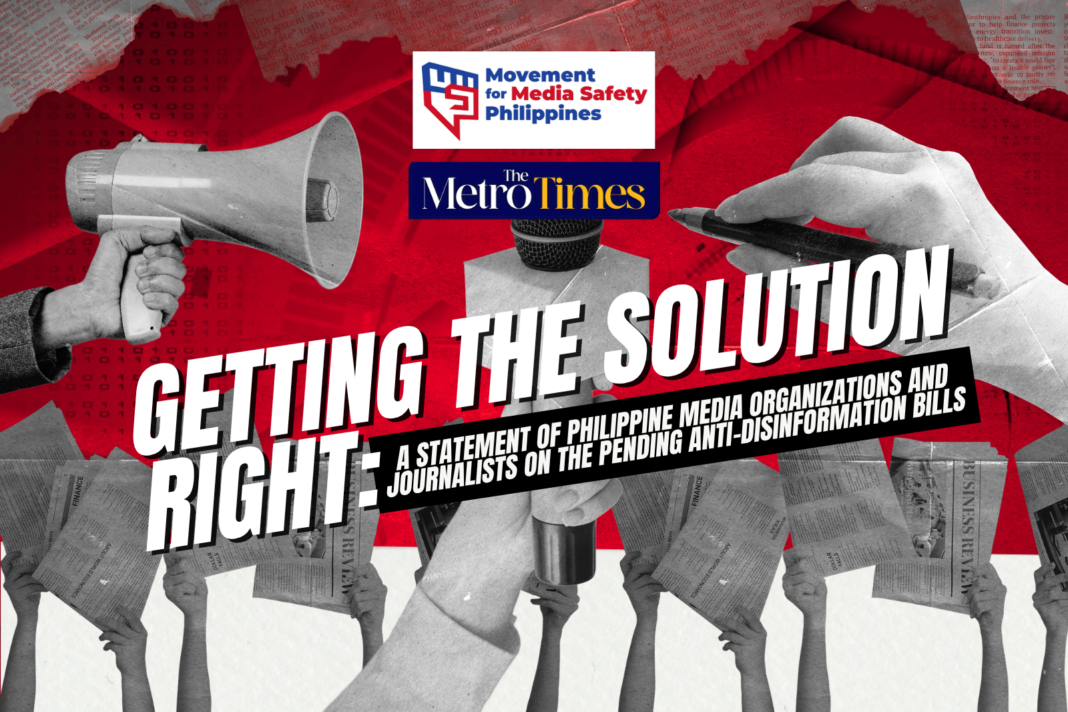

This is a joint statement of Philippine media organizations and journalists on the pending anti-disinformation bills.
The pending anti-disinformation bills confuse the symptoms with the disease. Instead of addressing the political, economic, and technological systems that manufacture and profit from coordinated information manipulation, they place the burden on individual expression and expand government authority over speech. This threatens democratic freedoms while leaving the real drivers of disinformation largely untouched.
As institutions and individuals whose work depends on verifying facts, exposing falsehoods, and informing the public, we have every reason to support effective measures against disinformation. Journalists are among those who experience firsthand the damage that disinformation inflicts on democratic discourse and public trust. We therefore recognize the urgency of confronting this grave challenge.
We support decisive and effective action against disinformation.
However, we believe the pending anti-disinformation bills (HB 9465 and its equivalent in the Senate) are the wrong response to a real problem.
Rather than moving to dismantle the architecture of disinformation, these measures primarily criminalize expression, expand the State’s authority to regulate speech, and create legal mechanisms that are vulnerable to misuse against journalists, critics, and ordinary citizens. At the same time, they leave largely untouched the opaque algorithms, commercial incentives, coordinated influence operations, and platform structures that enable disinformation to flourish.
In short, the bills risk weakening the constitutional freedoms that sustain democratic accountability without meaningfully addressing the structural causes of information disorder.
Our principal concerns
1. Existing laws already address many harmful acts.
Philippine law already provides remedies for libel, fraud, identity theft, election offenses, cybercrime-related offenses, and other unlawful conduct associated with deception.
Before creating new criminal restrictions on protected expression, Congress should examine whether existing laws are being effectively implemented and how transparency and accountability mechanisms can instead be strengthened.
2. Criminalizing speech is ineffective, fails to address systemic disinformation, and focuses on the small fry.
Criminalizing content is a blunt, disproportionate, and ultimately ineffective response that ignores the architectural roots of information disorder.
It functions as a legislative shortcut: while it risks criminalizing individual users – often targeting the “small fry” – it fails to reach the platforms, algorithmic systems, and coordinated networks that manufacture and amplify disinformation at scale.
Furthermore, criminal law is ill-suited to hold the true architects of manipulation accountable; it is notoriously difficult to enforce against extraterritorial entities, and it cannot effectively address the systemic nature of disinformation.
3. The bills fail to provide for meaningful mechanisms for platform accountability.
Digital platforms play a significant role in the amplification of disinformation, yet current legislative proposals focus disproportionately on content removal—a reactive approach that risks censorship while leaving the systems of manipulation untouched.
Platform accountability must move beyond merely forcing companies to suppress speech; it requires establishing clear, enforceable legal mechanisms that address the jurisdictional and operational realities of these entities within the Philippines.
Meaningful accountability demands transparency in recommendation algorithms, political advertising, and the infrastructure behind coordinated inauthentic behavior. Instead of incentivizing platforms to downgrade lawful speech to mitigate their own regulatory liability, the law should mandate independent auditing, standardized disclosure, and robust public oversight.
By shifting the focus from individual content to the technological architecture and the systemic operations that amplify falsehoods, we can address the root of the problem without eroding constitutional freedoms.
4. The bills create legal uncertainty that can easily be abused.
Broad and ambiguous definitions of prohibited speech invite inconsistent interpretation and selective enforcement.
Journalists routinely report on developing stories, disputed claims, whistleblower disclosures, leaked documents, election controversies, corruption allegations, and public health emergencies. These are precisely the situations where facts continue to evolve and public scrutiny is most necessary. Laws affecting expression must therefore be narrowly tailored and clearly defined. Otherwise, they create uncertainty that discourages legitimate journalism and public participation.
5. The bills risk making the State the arbiter of truth.
Government is frequently the subject of investigative reporting and public scrutiny. It cannot simultaneously serve as the ultimate authority on the truthfulness of speech concerning its own actions.
The antidote to falsehood is not government control over expression. It is greater transparency, timely access to public information, independent journalism, and more democratic debate.
A better way forward
Rejecting these bills does not mean accepting disinformation.
On the contrary, we believe the country urgently needs a comprehensive, rights-based strategy that addresses the structural drivers of information disorder rather than merely its visible manifestations.
Congress should instead prioritize measures that:
- Strengthen government transparency and pass the Freedom of Information law;
- Expose and regulate the financing of coordinated disinformation campaigns and influence-for-hire operations;
- Require greater transparency and independent auditing of digital platforms, including political advertising, recommendation systems, and coordinated inauthentic behavior;
- Support independent journalism, investigative reporting, and fact-checking initiatives;
- Strengthen media and information literacy and digital literacy across schools and communities;
- Encourage independent research into the country’s information ecosystem; and
- Promote genuine multi-stakeholder collaboration among government, media organizations, civil society, academia, and technology companies while fully respecting constitutional rights.
These measures strengthen society’s resilience against disinformation while preserving the democratic freedoms that enable truth to emerge.
If you wish to sign the statement, you may fill out this form: https://forms.gle/2MckoaQd1EUcXr3z5
SIGNATORIES:
Organizations
- Movement for Media Safety Philippines
- National Union of Journalists of the Philippines
- Altermidya Network
- Philippine Center for Investigative Journalism
- Vera Files
- Mindanews
- Philippine Press Institute
- Center for Community Journalism and Development
- UP College of Media and Communication
- Filipino Freelance Journalists’ Guild
- Peace and Conflict Journalism Network (Pecojon)
- Center for Media Freedom and Responsibility
- Bulatlat.com
- LiCAS News
- Probe
- Rappler
- Region 8 Media Citizen Council, Inc.
- Samar Island Press Club, Inc.
- Journalism Studies Association of the Philippines (JSAP)
- PressOne.PH
- Northern Dispatch
- Palawan News
- BicoldotPH
- Radyo Veritas Legazpi
- Media Association of Sorsogon Service Cooperative
- Bicol Files
- College Editors Guild of the Philippines
- Luzonwide News Correspondent
- Balitang Hilaga
- Davao Today
- Fyt Media
- Aklan Media-Citizen Council
- Surigao del Norte Media-Citizen Council, Inc.
- Pinoy Weekly
- PinoyMedia Center Inc.
- Manila Today
- Tudla Productions
- Panay Today
- Dampig Katarungan
- PanaySayon
- College Editors Guild of the Philippines- Panay chapter
- Kodao Productions
- International Association of Women in Radio and Television (IAWRT)-Philippine Chapter
- Baretang Bikolnon
- Mayday Multimedia
- Central Luzon Media-Citizen Council
- Batangas Media-Citizen Council
- Photojournalists’ Center of the Philippines
- Bicol Media-Citizen Council
- Asian Center for Journalism
- National Union of Journalists of the Philippines Baguio Benguet Chapter
- National Union of Journalists of the Philippines Metro Manila Chapter
- National Union of Journalists of the Philippines Albay Chapter
- FactsFirstPH
- Foreign Correspondents Association of the Philippines
- The Metro Times
Individuals
- Rowena Paraan, Philippine Center for Investigative Journalism (PCIJ)
- Ann Lourdes Lopez, Asian Institute of Journalism and Communication (AIJC)
- Ramon R. Tuazon, Asian Media Information and Communication Centre, Inc. (AMIC)
- Therese San Diego Torres, Asian Institute of Journalism and Communication (AIJC)
- Joyce Panares, Manila Standard/Philippine Press Institute (PPI)
- Red Batario, Center for Community Journalism and Development
- Carolyn Arguillas, Mindanews
- Ricky Bautista, Samar Chronicle
- Inday Espina-Varona
- Mark Z. Saludes, LiCAS News/Altermidya Network
- Jojo Pasion Malig, ABS-CBN News
- Felipe F. Salvosa II
- Jimmy A Domingo, freelancer
- Jonathan de Santos
- John Nery, Rappler
- Annie Perez-Gallardo, UP Cebu
- TJ Burgonio, Inquirer
- Redempto Anda, Palawan News
- Aireen Perol-Jaymalin, BicoldotPH
- Jes Aznar
- Reynard E. Sevillano, Radyo Veritas Legazpi
- Charlie Saceda
- Bobby Labalan
- Chantal Eco, Filipino Freelance Journalists’ Guild
- Villamor Visaya Jr., Luzonwide News Correspondent/Balitang Hilaga
- Leah Perez, CMFR
- Voltaire Tupaz, Fyt Media
- Jhoanna Ballaran
- Gerg Cahiles
- Kenneth Roland A. Guda
- Raymund B. Villanueva, Chairperson, Altermidya
- Reynard Magtoto, Baretang Bikolnon
- Carmela Reyes-Estrope, Newscore Bulacan
- Joenald Rayos, Balikas News Network
- Kathleen Lei Limayo, PCP
- Atom Araullo
- Arlene Burgos, Inquirer
- Al Alegre, Consortium on Democracy and Disinformation
- Maria Elena Catajan, North Luzon Monitor
- Paul Soriano, Chairperson, NUJP Metro Manila Chapter
- Gab Humilde Villegas
- Jomar Villanueva
- Gemma Mendoza, Rappler
- Laurice Angeles, Rappler
- Jairo Bolledo, Rappler; PUP Department of Journalism
- Samuel Medenilla
- Lourdes Escaros, RMN-DZXL/ NUJP
- Guien Eidrefson Garma, DZLB News, UPLB College of Development Communication
- Bobby Lagsa, Freelance Journalist
- Jodesz Gavilan, Rappler
- Pia Ranada, Rappler, FactsFirstPH
- Flordeliz Abanto
- Jb Deveza, Mindanews
- Patrick Cruz, Rappler
- Jelo Ritzhie Mantaring, Rappler
- Sheenalei Briana Rayos, The Metro Times